Happy Arbor Day

Posted in Acorn House on May 23, 2009 by acornhouseworkshop

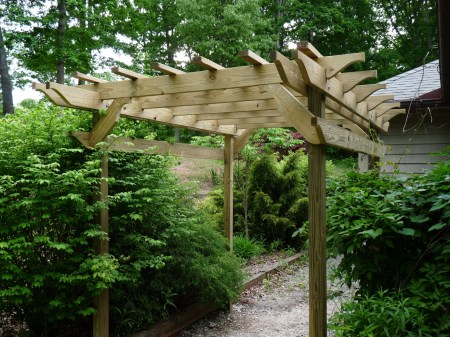
The weather has finally obliged with several dry, warm days, letting both materials and grounds dry out, so I was able to finish the arbor. After getting the corner brackets cut, fitted and attached, I tackled the long, top slats. Ripping 12 foot long 2 x 6s in half by yourself is a little daunting, but with the help of a carefully placed featherboard (thanks to Matt’s Basement Workshop schwag), a roller stand and a (mandatory!) splitter, it was accomplished. Then just a matter of working out the placement, drilling some pilot holes, and screwing away. Below is a pic with the wisteria ready to attack on the right.

With the carpentry out of the way, I can get back to fine (I hope!) woodworking, and the table. After tomorrow, that is, and a family get together in Columbus, where, with a little side trip, I hope to score a nice big slab of Mahogony.

Arbor

Break on through to the other side…

Posted in Acorn House on May 20, 2009 by acornhouseworkshop

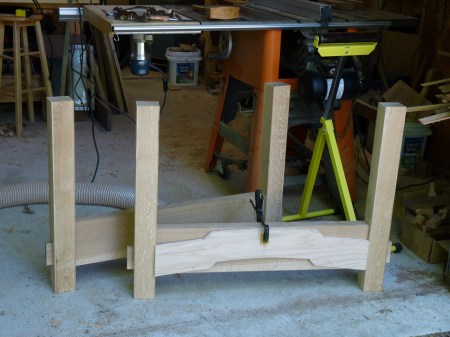
The veneer glue ups dried, and I drilled through the veneer into the mortise cavity. A few minutes with the router and chisels, and the through mortises are done.

I cut the shoulders for the tenons on the table saw and then took them over to the band saw to cut the cheeks. That worked well, but, I cut them a little oversized, since the through tenons need to be finessed to fit perfectly. I should have cut them a little bit closer to the finished dimensions. Trying to cut just a little more on the band saw doesn’t work well, since, without much meat on both sides of the blade, it wants to move towards the edge, leaving an uneven cut. Which meant a lot of handwork with the shoulder planes and chisels. It took me about one hour per tenon on the first rail. 

I decided to try the table saw tenoning jig. I had decided against it at first, because of the size (and weight) of the rails. However, with the aid of an extra clamp, it worked fine on the second rail, speeding up the process considerably. Since the tenons were about 4″ long, the saw blade didn’t reach all of the way, but a 1/2″ strip is a lot easier to plane down.

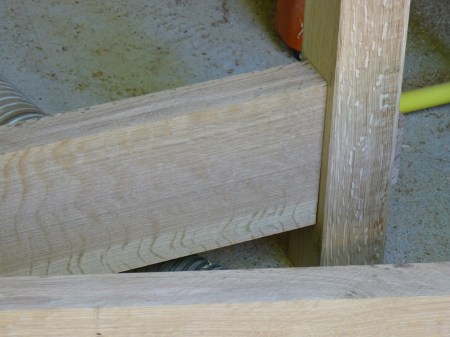
So the through tenons are done, only needing a little fine tuning of the shoulders (see pics below. The front one has the pattern for the final shape.). I milled the upper end rails and will get to the (non-through) mortises and tenons tomorrow.

legbridge

qswo

Getting a leg up

Posted in Acorn House on May 19, 2009 by acornhouseworkshop

OK, so its been a while since my last entry. While Spring brings the reentry into the workshop after the winter’s chill, it also brings other, time sensitive, commitments. First off, there are finals at school, and getting everything graded. Then, there has been a bit of landscaping that was necessary: removing overgrown shrubs and trees (memo to everyone; DO NOT plant Alberta Spruce next to a building. The backside will die back, leaving you with half a tree. Not my idea, btw; they were there when I bought the house!) and planting new ones. Then there is the small matter of the Wisteria that ate the house., Well, it was trying to, anyway. Last years growth had started to invade the soffet vent and climb the satellite dish cable. It definitely needed a home of its own. So for Arbor Day, I built, wait for it… an arbor! Well I started it on Arbor Day. Because of a boatload of rain, the final construction was delayed, which meant moving the 12 foot planks into the workshop to keep dry so they wouldn’t warp before everything could get bolted together. Which meant that there was no way to work in the shop. 

But, eventually, everything finally dried out enough to get the arbor erected (thanks Kevin and Benjy) and my QSWO was finally out of the kiln and delivered (on the same day as the arbor raising), along with some nice wide poplar and hackberry boards for future projects.

And so, to work!

I started with the legs for the dining table. I debated which method to use to get the quarter sawn ray flecks on all four sides of the legs, trying to avoid the natural, but less attractive, plain sawn figure on two sides. Stickley used two methods: mitering four thinner boards, leaving a hollow in the middle; and veneering the plainsawn sides with thin quartersawn slices. Since my design uses a through tenon for the lower rail, I decided to go with the veneer method. This way, I could start with an 8/4 thick board and use a dado blade to cut the mortise, then sister a 5/4 board to it, giving my the necessary thickness for the leg. I installed a new Wood Slicer blade in the band saw, (cut through the QSWO so easily, easily beating the performance of that canine brand), and resawed my veneer slices to 3/16″. I left them a little thick so that I could adjust the finished dimensions of the leg to be perfectly square. 

While the leg glue ups cured, I started milling the bottom rail stock. Let me tell you, 9″ wide 8/4 QSWO, nearly 4′ long, is quite a hand full. Even after ripping to the 7″ width that I need for my curved design, I got a nice workout at the jointer and planer. Tomorrow, after the veneer glue up has cured, I will drill through the veneers into the mortise, and clean them up with the router. Then drum sand to final dimension. Then I can make the tenons while the stock is still square, test fit them, and then and the curved cloudlifts.

It has begun!

Spanks a lot

Posted in Acorn House on April 24, 2009 by acornhouseworkshop

This has been my hectic week at school, with 2 concerts, 2 dress rehearsals, a staff/faculty dinner, in addition to my regular classes. I did find an hour or so to fulfill a rather unusual commission. I had had some students help me with digging out a walkway last weekend. (Here’s a tip, if you don’t like having to dig and haul thick, heavy, clay, don’t live in SE Ohio!) In lieu of payment, one of them requested a couple of fraternity paddles. (At least I ASSUME they were for a fraternity….) I grabbed a board from my walnut stash that had too much sapwood to be used for a furniture project, but would work quite nicely for this. The band saw and spindle sander, with the help of a few hand tools, made short work of it.

Next project (still waiting for my QSWO), is a display case for award plaques and other selected student work for the Fine Arts Center. It will be made primarily of Walnut, with Greene & Greene style finger joints for the cases.

Only two more weeks of school, then I can REALLY get some work done!

Going on Tilt

Posted in Acorn House with tags , , , , , , on April 18, 2009 by acornhouseworkshop

Had another sharpening session today. I am definitely pleased with the new machine. I can’t wait to use my nicely honed chisels and planes and see how long the edges last. In the first round of sharpening. I did some plane irons and a couple of old mortising chisels. The water did a super job of keeping the steel cool, not even a hint of blue, even while grinding a new angle on one of them. When I started on my first bevel-sided bench chisel, I noticed that I was not grinding perpendicular to the shaft, even though the chisel was firmly seated against the side of the jig. I could not, for the life of me, figure out what was going on.

Today, I tackled the rest of my metric Narex chisels, and had the same problem with the first one. Then, a light dawned. Well, not dawned, but peeked through. I noticed that the clamping plate of the jig was pushing down on one side of the chisel more than the other; and, even with a 20mm chisel (about 3/4″), that was enough to twist the chisel ever so slightly on the beveled side. Once I saw that, I readjusted the clamping plate so it was evenly applying pressure left to right, and was able to get a good 90° edge, even on the small 6mm (1/4″) chisel. Got a nice little production line going and finished the job in no time.

No more tilting at windmills, or grinding stones, for me!

Turn, turn, turn…

Posted in Acorn House on April 16, 2009 by acornhouseworkshop

The last few days have been colder and wet, well, just blah. The cutting board is getting it’s mineral oil. I am up to 3 coats so far, maybe just one more. I am letting the oil dry for a few days between coats. I know they say one day, but I think that’s too quick to really cure. I’m still waiting for my quarter sawn white oak for the dining table to finish in the kiln.

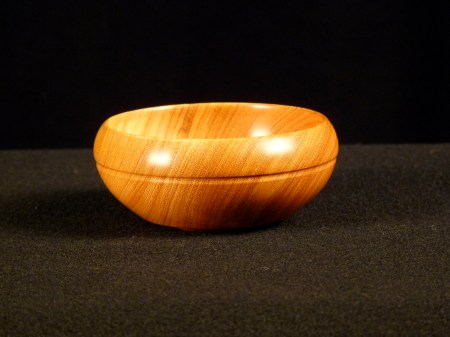
Today, the sun finally returned, so I grabbed a bowl blank from my stock and went out to turn a small bowl before going in to school this afternoon. The wood that I grabbed was (from the Westpenn site): 

Chico Zapote Pouteria sapota. A hard, dense wood from Central/South America. Color varies from a deep, solid reddish-brown to a light reddish-orange, and often a combination of both colors. Sapwood is cream in color, and makes for a nice contrast against the red hues. Tree is typically used to make chewing gum!

It was definitely from the orange part of the tree. It turned beautifully with both gouge and scraper. I finished it just with some EEE-Ultra Shine polish after sanding to 400 grit. It really puts a nice polish on it and, depending on the wood and the use of the bowl, can stand on its own without any further finishing product. A small, fairly simple bowl, but sometimes that’s all you need. Later this summer, I think I may try to do some larger, segmented bowls.

bowl1


Divine Inspiration

Posted in Acorn House on April 13, 2009 by acornhouseworkshop

The Smithsonian is holding an exhibit of Greene & Greene in their Renwick gallery until June 7th. In addition, they have posted an online history and exhibition on the Greene’s and their legacy. The online exhibition can be found at:

http://www.gamblehouse.org/nnb/

I have always found the Greene’s blending of Arts & Crafts and Art Nouveau styles to be a step above the typical Craftsman style of Stickley. (Which, don’t get me wrong, is still a very fine style; the Greene’s just take it to another level.)

Cutting Edge

Posted in Acorn House on April 12, 2009 by acornhouseworkshop

I was able to find a space for, and set up, the new TiGer 2000 wet sharpening machine this weekend. While this machine is, by no means, new on the market, or even readily available anymore, my initial impressions may interest someone else interested in purchasing a similar machine by one of any number of other manufacturers.

First off: set-up. As has been mentioned in all of the reviews since the machine was introduced in the US, the – for want of a better word – “manual” is, shall we say, concise. Not much to it, but enough to set-up and start working, with a few tips sprinkled in. The machine comes fully assembled with the exception of the blue aluminum oxide grinding wheel. Bolt it onto the shaft, snip the twist tie securing the electrical cord (for shipping), fill the tray with water and you’re off. Have plenty of water available (I used distilled; I don’t know if it makes a difference from tap, but I had some on hand.), the dry stone will soak up quite a bit initially.

Flattening the back of the iron or chisel is done on the side of the stone. I find I much prefer to hold the tool steady against a moving wheel than having to move the iron on a stationary stone. A sharpening jig for flat chisels and plane irons is included, as well as an angle gauge. Make sure you have the iron/blade snugged up against the jig so that you get a true 90° angle.  Slide the jig onto the guide bar and grind away. The water definitely keeps things cool; it also makes go slower than grinding on a dry wheel. But, of course, that slowness is what helps to avoid overheating the steel and blueing the edge, ruining the temper. If you are not changing the angle, it won’t take too long; even grinding a new angle, as I did with an old mortising chisel, isn’t too bad. After all, you’re not likely to need to regrind the angle too often, once you have it where you want it, you’ll just be honing or doing light touch-up grinding. Here is where a minus showed up. When moving a wide plane iron back and forth over the stone, the water gets pushed over the edge of the stone. On the outboard side it, of course, goes into the tray, but on the inboard side it cascades over the machine’s outer case onto whatever work surface you’ve placed the machine. I may need to get some melamine to protect the plywood of my utility bench.

After grinding, you smear some polishing compound onto the leather wheel for final honing. This removes the burr and puts a nice polish on the ground bevel. The result is a VERY sharp tool. After sharpening the iron of my bog standard, WWII vintage, Stanley No. 3, I clamped down a small elm board and tested the result. I got a very satisfying “sssssshhhhhick” as lovely thin curls emerged from the plane with little effort. It made me want to keep planing. I then turned to the freshly sharpened mortise chisel (again, just an old, no name, chisel) and chopped out a 7/8″ deep mortise in the elm with no trouble at all. Even more impressive was the fact that AFTER chopping out the mortise, the chisel seem to be just as sharp as when I had started. 

So the verdict. Is it a miracle machine? No. It can get messy, and it still takes some time. The finished result is not a flawless mirror finish, although it is quite shiny and VERY, very sharp. But then, does every tool NEED a mirror finish to the edge? For regular planes and chisels, this will give me an extremely sharp edge that seems to be quite durable. For those tools like a final smoothing plane or paring chisel, I can go my waterstones after the initial grinding to remove ALL of the stone marks, before final polishing. Am I glad I bought it? Most definitely. For me, I like the fact that I can get a consistent edge with the jig. I don’t have to worry about rocking the steel as I move it over the stone and getting an edge that is not quite perpendicular. As long as I set it up correctly (and that is not too hard to do), the jig keeps the steel steady while the STONE moves, and you can’t help but get an even edge. It is the cutting edge that counts, after all.
“Plastics, Benjamin, Plastics!”

Posted in Acorn House on April 10, 2009 by acornhouseworkshop

The ulu cutting board is finished, just a couple of coats more of oil. While waiting for each coat to dry, I took the opportunity to experiment with a couple of acrylic pen blanks that I picked up on sale. I’d never turned acrylic before and, after finishing these two, I can safely say that I won’t be doing much of  it in the near (or distant) future. 

Not that it was all bad, there is no grain to worry about, so going uphill or downhill with the gouge is not an issue. The end product is nice and sparkly and colorful; in a sort of Vegas revue type of colorful. No, the biggest issue I had with working with acrylics is the horrible odor during every cut. Sort of like the smell of CA glue (not quite as potent, thankfully) – very unpleasant. Also, once the blank are round, each pass of the gouge produces long strands of plastic that wrap around the turning, so much so that you can’t see where you are cutting. So, you make a pass, pull off the wrapped strands; make a pass, pull off the wrapped strands; on and on and on… And, like those styrofoam peanuts, the plastic bits have a static charge that attaches them to the lathe, the tools, etc.

So, give me some nice figured maple, and I’ll deal with the difficult grain. I’ll take style and substance over flash and sparkle any day. Give me the grace and elegance of a Jaguar XJS over  the speed and eye candy of a Ferrari. (No, please, really; give me a Jaguar!) “Plastics” indeed!

Brrrrrrrrrrrrrrr.

Posted in Acorn House on April 7, 2009 by acornhouseworkshop

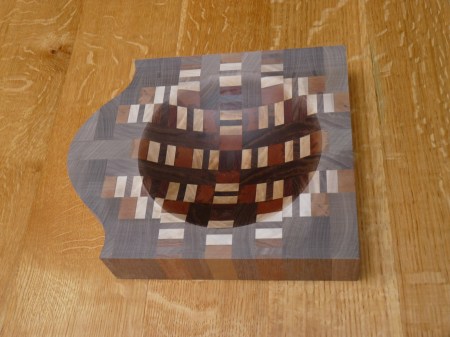
A cold front moved in, bringing with it some snow, and a frigid shop. Luckily I got all of my glue-ups finished this weekend, when it was still in the 60’s. I surfaced the board at the drum sander. I hadn’t noticed that my (only) strip of 80 grit paper had gotten a little too worn; leaving me to have to resort to 120 grit to do the thicknessing. On normal face grain, this would be perfectly fine, but end grain is another story.  Definitely need the coarser stuff to tackle that. (Hope I remember to stock up before the next endgrain surfacing job.)

I installed a brand new 1/4″ blade in the band saw (new, sharp blade cuts SO easily, who’d a thunk it?), cut,  and sanded the top to shape; sort of a clock/spice cabinet s-curve that fits well with the quilted mosaic of the board. Now all that is left is to ease the edges and do the finish sanding, and then a few coats of mineral oil. I have been debating which finish for the board: pure mineral oil, oil and wax mixture, or the oil/varnish salad bowl formula that some recommend (Wood Whisperer, you know who you are!). I decided on the straight mineral oil finish as the easiest one for the client to maintain. Yes, you have to reapply more frequently, but the oil is cheap, readily available, and anyone can do it. A light sanding (if desired), slather on the oil, let it soak in, then wipe off. Easy peasy. 

clockboard