Backing up

Posted in Acorn House on September 16, 2009 by acornhouseworkshop

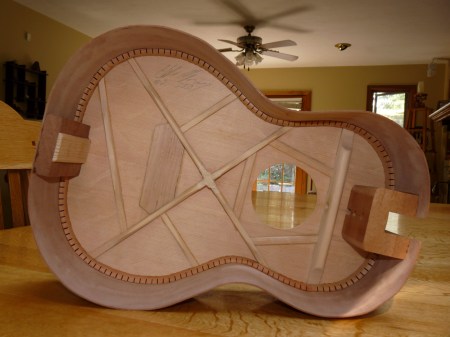
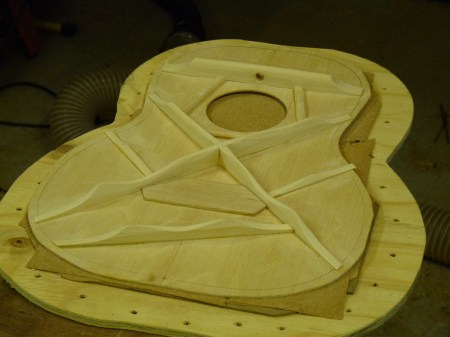
The bracing for the back is much simpler than the soundboard bracing. The back won’t be facing the stresses of the strings’ tension, and, acoustically, it is not in direct contact with the strings’ vibrations. (although it still needs to be somewhat resonant) A center seam of cross grain spruce is glued to reinforce the joint of the two halves. Then cross bracing, slightly arced towards the tips, is glued perpendicular to the center seam. A very simple scalloping at the ends finishes the backbracing.

backbrace

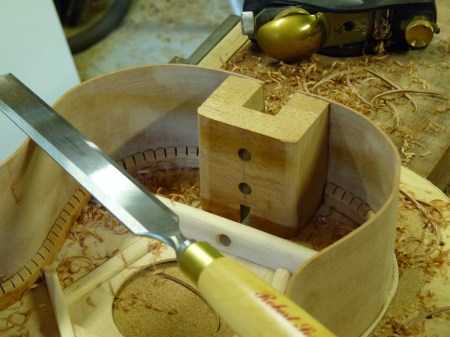
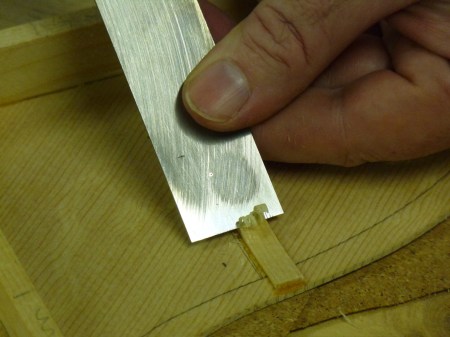
Before gluing the back kerfing, however, the sides need to be sloped. While the top of an acoustic guitar is (mostly) flat, the back tapers halfway, so that the headblock is shorter than the tailblock. A good paring chisel and block plane are essential here. Then, after getting as close as you dare with them, you break out the sanding board, a long flat board of plywood with sandpaper attached, to evenly flatten both sides according to the newly added slope.

slanting

Now we’re ready to add the back kerfing, and then attach the back. Then, the basic construction of the body is complete. All that’s left is the binding, finish sanding and smoothing, making the bridge, and adding the finish, glueing the bridge, and doing the final setup of the nut and saddle. Still much to do, but the end is in sight; way over there in the distance, but in sight – especially if you squint!

Dropping name(sake)s

Posted in Acorn House on September 14, 2009 by acornhouseworkshop

Thanks to the beginning of the academic year, and the forced attention to some naughty wisdom teeth, I was kept out of the workshop for a bit. Thankfully, I’m now back to work on the guitar. And not a moment too soon, as I’ve seen the first acorns of the season on my drive. Soon, I’ll have to break out the hardhat to make it to the workshop without getting knocked senseless.

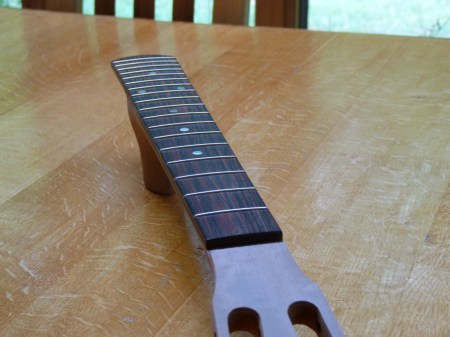
First, a couple of pics. I had a request for a pic of the fretboard with the frets installed.

Frets

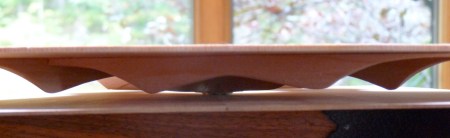
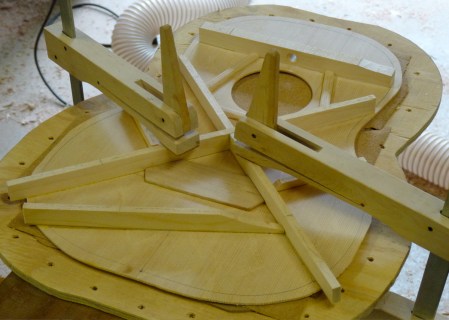
Next is a view of the bracing that will soon be hidden from normal view; but I thought it was an interesting perspective.

batwings

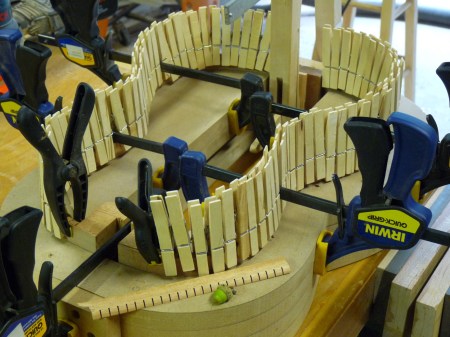
Now, back to the task. After glueing the sides to the head and tail blocks in the form (done before my hiatus), I turned to the kerfing. Because the sides of the guitar are so thin – .090 inch or so – there is very little glue surface to adequately secure the top and bottom plates. In order to beef up this area, guitarmakers a kerfed lining, usually of mahogany or basswood; the thin, regular, kerfs cut in it allow it to bend around the curves of the side. (Classical guitars tend to just use a plain strip that is pre-bent, with no kerfings.) You need lots of clamps, so a trip the store to clean out their supply of spring clothspins is the easiest solution. You can see a piece of the kerfing (with the season’s first acorn) in front of the clipped sides. There are a couple of different types of kerfing available, I use the reverse kerfing, with the cuts on the outside, toward the sidewalls. The more traditional version puts the kerfs away from the side. Both do the job, but I think the reversed kerfing is a bit easier to apply.

walloclips

With the kerfing for the top glued on and leveled, notches need to be made in the kerfing to allow for the top’s bracing to extend to the side. Then, after many test fitts and adjustments, with the help of many cam clamps and a long length of bicycle inner tubes tied together, the top is glued on. The inner tubes are wound tightly around the clamped top, apply pressure over as much of the surface as is possible.

Next the back will need to be braced, and then the back can get attached. Its beginning to look like a guitar. Now is the time to sign the guitar, while the box is open. Its good to be back.

topdown

Getting bent out of shape

Posted in Acorn House on August 15, 2009 by acornhouseworkshop

Got two tasks accomplished since the last post; one went swimmingly, the other tried to drown itself. The first task, hammering the frets in the fingerboard, went surprisingly smoothly. Last year, I seemed to have nothing but problems with the frets: lifting, unevenness, going too far in. This year I mad a few changes. First, I decided not to use any glue. Some books recommend adding a bead of pva glue to the fret tangs before hammering them in, some say not to. Last year I did, and it meant more work cleaning up the fretboard afterwards, and didn’t seem to do much. This year I went without: no problems! I wonder if the glue wetted the wood just enough to cause problems with the tang gripping the slot? The fretboards were both types of rosewoods, but this year’s is made from Cocobolo, which I think is much harder than regular Honduran rosewood. On a fingerboard, harder is better; certainly for holding onto the fretwire’s tangs (teeny barbs that keep it in the slots). I also sprung for a brass fret mallet, which seemed to work much better than the Warrington pattern hammer that I used last year. Being softer than the fretwire, I didn’t have to worry about denting as I hammered them in their slots. Lastly, I used a much better quality fretwire, which had a copper alloy with the steel rather then nickel, making it (again) much harder that the regular wire (and gives it a gold color. very flashy!). Of course, the fact that I have done it before, this time, might also have helped matters. Regardless, I got all of the frets hammered and dressed with no problems. I can’t wait to get the strings on!

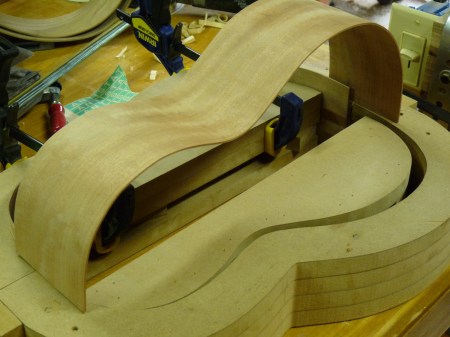
But, I’m getting ahead of myself. The next task, the one that I was most worried about, was bending the sides. Last year, I had a couple of practice sides made up, and bent them first, giving me a little practice. This year, with the curly moabi, I didn’t have any extra available, due to the problems resawing. This was a mistake. Not having worked with the moabi on the bending iron, I didn’t know how it would react. I soon found out. Starting from the thicknessed (to 2mm), flat, side, I filled the bathtub with hot water, and let it soak for 15 minutes or so.
sideflat

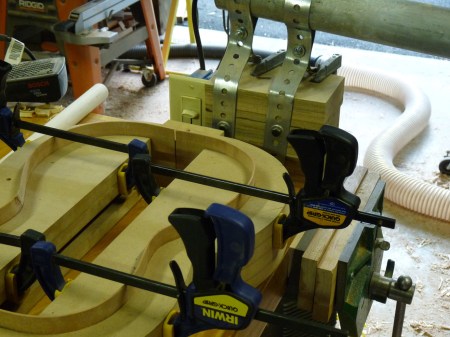
During this time, I turned on the bending iron (homemade), and got the forms and clamps ready. One thing I improved upon, this year, was making an inner form. It makes clamping the bent sides up to dry, much easier, and gives a much more controllable and consistent end result. I started bending at the waist. Now, last year, I bent the walnut sides without a flexible backer plate, and didn’t have any trouble. Ah, moabi. From that first bend, I started getting some cracks on the outside. I immediately shut everything down to consider my next move. So far, the cracks were on what would be the inside of the guitar; and were not structural, purely cosmetic. I decided to make the run to Stew-Mac, in Athens, to get a flexible bending plate. (Hmmm, they have put an article on bending sides on the front page. I wonder if they got the idea when I was talking with them about it, when I picked up the plate?) The next day, I tried again, with the rest of the curves on that first side. The plate helped, but there were still some minor cracks. Now what?! Do I try to fix the cracks, which, again, were not structural, just cosmetic; or do I use the practice walnut sides form last year, which would not match the moabi headstock veneer that I had already inlayed?

I decided to break out the CA glue, and see how the cracks would look after repair. I had to use the bending iron (unplugged, of course) to clamp the crack closed, since everything was a curved surface, now. It looked to be working. It might not be perfect, but with some grain filler, it should feel nice and smooth. And, using that first side as the bottom side, hopefully it won’t be as noticeable. The second side went much better. I was finally figuring out how to work with the moabi. I only got on minor crack to repair. If only I had gotten that third side out of the stock when I was resawing, I could have made all of my mistakes on it. I guess I’ll have to lower my price a bit when I go to sell this one.

Here are the sides clamped up in the forms; note the hi-tech bending iron behind it. You can also see that first crack in the inner wall of the waist. The kerfing will reinforce and hide that.
sidesiron

Holding its own (shape). I think I got more bent out of shape than the sides!
sidebent

Brace yourself, for a little scallopini

Posted in Acorn House on August 5, 2009 by acornhouseworkshop

Acoustic guitars, the kind that most people know, are commonly called “flattops”, to distinguish them from the archtops found in the jazz world. They are not really flat; well, not completely. In order to appear flat, the tops (and bottoms) are actually arced slightly. This helps strengthen the box construction; and, if they were built completely flat, they would look slightly concave. So, all of the bracing has a slight arc built in to them; no more than 1/8″ deviation from flat. 

With all of the braces prepared, arced, and glued, its time for the next fun step: carving them. The bracing adds a lot of stiffness to the top, giving it a bright, clear ringing sound when tapped. But, it makes it too stiff, there would not be enough resonance; the sounds of the strings would not sustain well. So, after adding all that stiffness, we need to carve away some of it, to achieve more vibration. Its a big balancing act. You have to carve enough away for a good sound, but leave enough structure for strength…and a good sound. Here are the braces before (mostly) carving.

brace1

The transverse brace at the top get the first shaping, thin at the ends to fit under the side kerfing, but thick in the middle to support the neck. Here’s where a good paring chisel gets a workout. That’s part of the fun of guitarmaking; you get a lot of hand tool practice. A delicate touch is critical here.

bracepare

A little sanding, and ready for the next one. The hole, by the way, is for the allen wrench used to adjust the truss rod.

bracetransverse

The lower brace, and the two small side braces, are all about the sound. They don’t really do anything for the structure, they are there to help transmit the string’s vibrations throughout the top. As such, they don’t need to be too massive, and receive a more interesting scalloped treatment. Thinned at the ends, they come to a peak – thinned horizontally – with another, central scalloping for the longer, lower brace, similar to a suspension bridge.

bracescoopbracescallop

The final braces are the most important. These are the X-braces that Martin developed, that really enabled the development of the steel string acoustic guitar. Previous bracing layouts were meant for gut strings, and would be too weak too counteract the tensions that steel strings put on the guitar. With the X-bracing, the force is spread out to the entire top. But, again, we don’t want to make it so stiff, that the sound is deadened. So we need to scallop the ends, while keeping the central X, near the bridge plate, solid.

bracenox

The final touch to the bracing will be a linen patch glued over the lapped X joint. It doesn’t add a lot of strength, but it is very traditional. I may fiddle a bit more with a brace or two, tapping all the time, trying to find that elusive “perfect” balance.

bracedone

Next up, will be the bending of the sides. Strike up the barbie!

A rosette by any other name…

Posted in Acorn House on August 2, 2009 by acornhouseworkshop

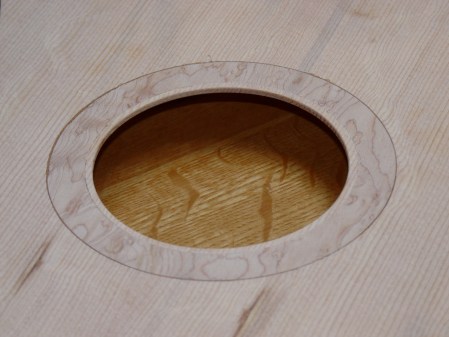
I debated, a lot, what to do for the rosette. In the first guitar, I used a simple half inch wide circle of carpathian elm burl veneer; routing out the channel around a central nail, and sizing and glueing in the veneer. That worked ok, but trying to cut the thin veneer to fit the routed circle was tricky; my drill press circle cutter just tore the piece to shreds. I ended up with an X-acto knife blade stuck through a thin stick, revolving around a nail, which left a slightly, very slightly, out of round circle (You have to look magnifying glass close to see the gap.) So I wanted to try something different this time. Also, I thought the elm would be too dark, for the lighter moabi back and sides; and would overpower the bearclaw figure of the spruce. The purpose of a rosette, by the way, is to add a little bit of reinforcement around the soundhole; the inlaid material, acts as a stop for any cracks that might form. I could have gone very simple, and very traditional, with some white and black stringing. But that was a bit too understated. I finally settled on some birdseye maple that didn’t have an abundance of eyes, but did have some nice grain patterns; fancy, but subtle, and not taking anything away from the spruce. I could also, with this thicker board, use the circle cutter without fear of shredding. In order to provide a little bit of separation between the maple and spruce, I wrapped a slice of mahogany veneer around the donut of maple.

After that had dried, and been drum sanded to thickness (if you want to get into acoustic guitar making, I cannot recommend having a small drum sander enough. Its makes life SOOOO much easier), I set up the router to rotate on a nail with a spiral bit to cut the channel. One thing about spruce and routers, you get a lot of “fuzz” around the edges of the cut, and I even got a tiny bit of splintering on the outside edge. Sigh. I’ll wait to see how it looks after finish sanding and finishing to decide whether to add a pickguard or not. I hadn’t planned on one for this size guitar, but, it would easily hide the tiny divot. 

rosette

After glueing, clamping and sanding flush, I cut the soundhole out. Boy, it’s beginning to look like a guitar! With that accomplished, I turn to the bracing.

Wah-fer theen!

Posted in Acorn House on August 1, 2009 by acornhouseworkshop

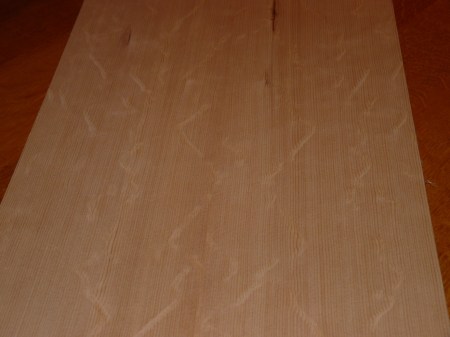
One aspect of guitar making that most woodworkers will never deal with is the challenge of joining very thin boards, less than 3/32″  of an inch thick. Traditionally – and practically – the top and back of acoustic guitars are made from two bookmatched boards edge glued together. When making furniture, you would glue the two boards together, then apply clamps all along the edges to bring the joint tight together. With the thin boards for the guitar, especially the soft spruce or cedar used for the soundboard, this would not work. It would, at best, bow the boards up, opening the joint; and, at worst, crush the wood. So the whole thing gets flipped around. The clamps are set in place first; either two long boards or straight edge clamps, or, very traditionally, a series of nails along the edge. These clamps are set slightly narrower than the width of the two boards; just enough so that, after apply glue along the seam, you can press the two boards flat, tightening up the joint. Then paper is put over the seam, and finally something heavy so that it doesn’t spring back up. If the setup is done carefully, the result is a very strong, very flat, joint that practically disappears, especially in the spruce. By the way, the spruce that I am using is a special, rare, figured sitka spruce commonly called “bearclaw,” for the markings that look as if a bear had drug its claws through it.

bearclaw

The back, made from curly moabi (African pearwood), is done the same way. With the bonus step, as I discovered, that moabi, being a very hard, dense, wood, is not fun to resaw. (It made me pine for the days of resawing White Oak.) I initially wanted to resaw three or four pieces from the 1/2″ boards for the back and sides. After some complaining (smoking, drifting, stalling) from my bandsaw, I ended up with two pieces, and a lot of time at the drum sander. Oh yeah, while the moabi is lovely straightgrained, quatersawn stock, the curls make planing a strict no-no. 

After the glue cured, and the final thicknessing is done, its time for some critical drafting. Even though guitars are made from very thin wood, the final product is incredibly strong, thanks to the bracing of the top and back. Remember, the strings exert a huge amount of force on the bridge and top, and, without the bracing, they would rip the top off the guitar. Yet, they still need to allow for the vibrations of the strings to transmit the sound through the wood. This type of X-bracing was developed by C.F. Martin in the 1840’s, and is still the preferred design for steel strings today. I just transfer the layout lines from the plan. The first guitar has an amazingly big sound for such a small instrument, so no need to try anything different.

bracelayout

Mahogany flowing under my fingers

Posted in Acorn House on July 28, 2009 by acornhouseworkshop

The last couple of days have been spent carving the neck. Once again, like most luthier tasks, it’s all hand work, with rasp, file and sandpaper. Oh, sure, you can use some fancy-schmancy computer aided carving machine, and get a perfect neck like the big boys, but, really, where’s the fun in that? Where’s the soul, where’s the love? Where’s the tendonitis? Actually, it is rather enjoyable and rewarding, coaxing the curves out of the blocks of mahogany that were carefully glued up. It’s also where some of the artistry comes in to play. The body is shaped to a form, but the neck is all by feel; finding the most comfortable shape for the hand, deciding on how the heel will flow from the neck, finessing the transition from the neck to the headstock. The only critical measurement is to make sure to leave just enough wood under the truss rod channel, around an 1/8th of an inch. (More than that, and the truss rod loses its ability to make adjustments easily; less, and the structure is compromised, and the truss rod might break through.)

So, the shaping is done; although I expect to fiddle with it until the final assembly, tweaking, smoothing, and sanding, trying to get it juuuuuuuuuuuuuuuuuuuuusssssssssssssssssssst right. Next comes the soundboard glue up and its bracing.

neckbackneckshaped

Dining out

Posted in Acorn House on July 27, 2009 by acornhouseworkshop

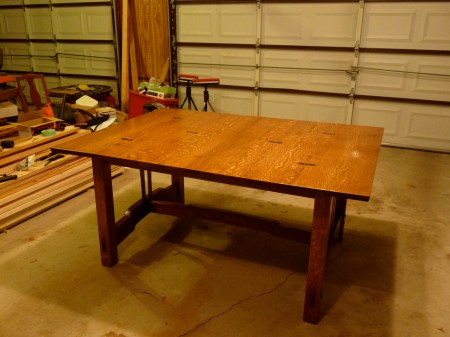
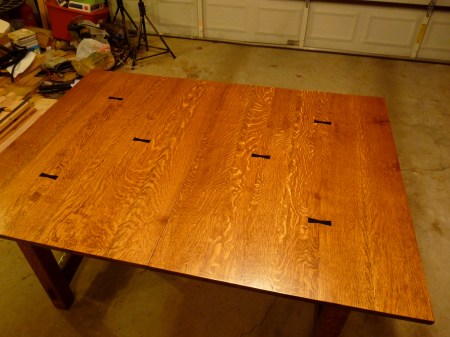
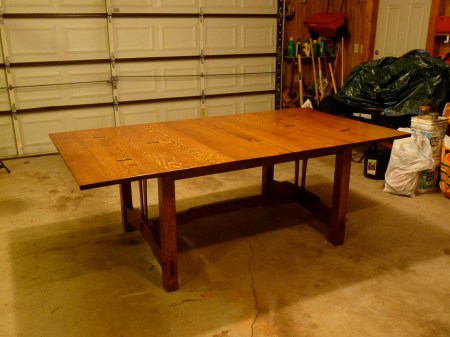
The dining table is finished and delivered (well, picked up). I got all of the extension slide parts made and installed; which meant laying on my back on the garage floor, and drilling a lot of holes. I even had to go old school with my Millers Falls hand crank drill to get in some tighter spots. It worked just as good as the power drill. Then, of course, I had to fill all of those holes with screws. Fun, fun fun!

The last parts to add were the brass alignment pins and the solid brass table keeper (to keep the two halves locked together). That’s when the problems started. I don’t know if I got a poorly made one; or if the table leaves were less than perfectly parallel, but after installing the keeper, and tightening the screws (snug, but not overtight), the keeper part would not come out of the catches. It was locked in. Sure, it kept them locked together very nicely, however, I also expected it to be able to unlock! Very disappointing. I have used a cheaper, plated, type before, which worked fine. That’s what I get for trying to class it up a bit. Off it came. The top should stay together ok; if not, then we’ll slap on one of the cheapie keepers, THAT WORKS!

Then it was stuffed into a Subaru Forrester (and I mean STUFFED!) for the journey up to NY. Who needs leg room to drive, anyway? At least they won’t have to wait for a table, along the way!

diningshort

diningtop

dininglong

Hittin’ the slots

Posted in Acorn House on July 21, 2009 by acornhouseworkshop

With the delivery date of the dining table fast approaching, I had to switch focus back to it, and away from the guitar. The top is just about finished in the finishing room, so I had to fabricate the extension slide mechanisms. It will have a two-part system. Runners will slide in grooves in the side aprons, providing the bulk of the support. In addition, I have made two dovetailed slides to bridge the center gap, giving a little added support. They will extend through the notches in the end aprons, and also help to keep the table tops flat.

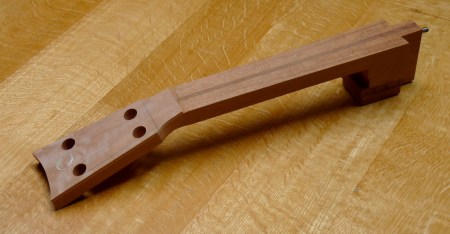
I was able to get a little more progress on the guitar neck (when not watching the coverage of Le Tour). I connected the two holes in the head (the guitar’s head, that is) into the slots using the scrollsaw. Because of the myriad angles, I prefer not to try to use a router. Aside from the added work of trying to get a jig set up, I am much more comfortable with a paring chisel and scrollsaw. If a slip happens with them, there is not much damage done, but with a router, one errant slip, and the neck would be ruined. EVERYTHING would have to be redone! A commercial shop, with an endless supply of mahogany, can afford to trash a neck or two. I’ll take the tortoise’s approach. So the slots are finished, save some sanding, and the final ramps for string clearance. I also was able to shape the fingerboard, and get it glued to the neck; and then inlaying the MOP dots. (I buy my fingerboard blanks preslotted. The frets have to be precisely positioned for accurate tuning, and it would cost more for the tools to do the job than to have my supplier do it. If I get to the point where I am making enough guitars to make it economically feasible, then I’ll do it myself. That is the only non-self made, wood, aspect to the guitar.)

The astute amonsgt you may have noticed in the pic below, that there are only four tuners. No, I am not making a ukelele. My commercial self-centering dowelling jig is to large to fit near the angled neck, so I will have to make another jig, to get the last two tuner holes drilled. Ah well. I’ll get back to the shaping soon enough. In the meantime, Go Lance!, Go Alberto! Get well soon, Jens.

slotted

Chiropracty

Posted in Acorn House on July 16, 2009 by acornhouseworkshop

With the neck and headstock overlay all glued up, it was time for layout. Because of the headstock angle, after doing all the layout on the top of the neck, I had to transfer everything to the underside, so that I could lay it flat, upside down, at the bandsaw. (Now where can I find some transparent mahogany?) Cutting close, but leaving the lines, I finished up doing some hand sanding at the flat granite surface plate and some time at the spindle sander.

This guitar, like the last one, will use a slotted headstock, with the tuner posts coming in from the sides, rather than a solid head with the tuners coming from underneath. I think it looks better on the smaller guitar, and gives it a more 19th century look. So after laying the boundary points for the slots, I drilled four 5/8″ holes through my head. I will use the scrollsaw to connect them, and finish off with a very sharp chisel.

neck

Next will come the hand shaping of the heel and the contouring of the neck. This is the real fun. Here is the close up of the head, with the overlay sandwich. Can you see the scarf joint? (Didn’t think so; isn’t mahogany wonderful!)

head