Head and Shoulders

Posted in Acorn House on July 15, 2009 by acornhouseworkshop

The guitar neck glue up went well. Counting the heel block pieces and the bookmatched (to get a stable quartersawn end product) neck and headstock pieces, the neck is made up of 10 individual pieces, taken from the same , relatively small, board (18″x4″x1.5″). Talk about frugal!

The next step was to create a channel for the truss rod. For non-guitar people, the truss rod provides a way to adjust the straightness of the neck and counteracts the tension put on it by the strings. After ripping the channel on the table saw, I put a spline above the truss rod, leaving a full surface to glue the fingerboard to, and a nice, tight, fit for the truss rod.

trussspline

Then it was time to create the holes for the bolt assemblies and the tenon. The traditional joint for an acoustic guitar neck has been a dovetail. On cheaper models, they may simply bolt on the neck. However, because of the inevitable need to adjust the neck’s set (the angle that it attaches to the guitar) over time, more and more custom builders are turning to a bolted tenon system. This provides a very sturdy joint, that is easy to adjust, when the time comes.
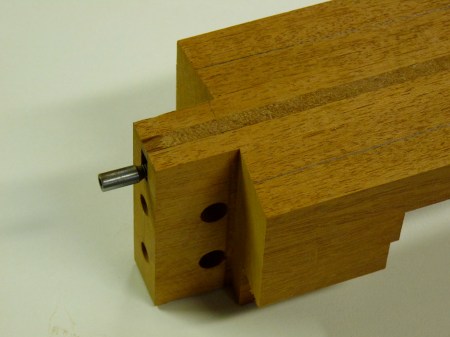
holytenon

The last task, before shaping, was to inlay the acorn logo into the headstock overlay, in mother of pearl (MOP). I had been worrying about this one, since I have not done marquetry inlay before, and dealing with the hard, yet brittle nature of the MOP adding to my trepidation. But, I must soldier on. I glued the MOP to the overlay, and the acorn pattern to the MOP, drilled two tiny holes with a pin drill, and fired up the fretsaw with a 2/0 blade. I decided against the powered scrollsaw, so that I could have more control over the cuts. (I don’t have a terribly good scrollsaw.) Many saw strokes later (man, MOP is hard!), I had a reasonably good inlay, ready for the CA glue. Perfect? Maybe not, but certainly acceptable.
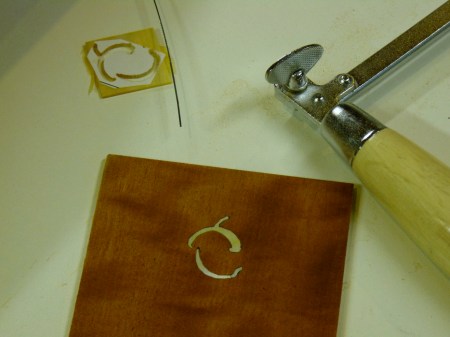
acorninlay

That gets glued to the headstock, with a maple veneer between it. Next up will be cutting the final profile of the neck and head, and then breaking out the rasp, chisels, files and gouges.

De plane, de plane!

Posted in Acorn House on July 10, 2009 by acornhouseworkshop

The table top panels are in the finishing room. It was an ordeal to get down to the final, finish surface. Because of the size (and weight!) of the panels, it was going to be impossible to use any stationary tools; definitely had to bring the tools to the work, rather than the other way around. Since I abhor the handheld belt sander, that meant hand tools the whole way. Veritas to the rescue! I sharpened up my No. 80 cabinet scraper to do the bulk of the smoothing at the glue lines, then turned to the bevel-up smoother with a high angle blade to deal with the final pass on the figured QSWO. It sure works as advertised.

I used a simple 15° bevel on the bottom edge with a slight roundover on the top for my edge treatment. Then a final sanding to 120, and over to the finishing room. Now all that is left is to fabricate the extension slide mechanisms.

Now that that is (mostly) finished, I am turning to the next project. Definitely on a smaller scale, I’m starting on a second parlor guitar. I want to take my experience from building the first one, and perfect my build techniques. I am using a nice board of curly moabi for the back and sides, and some bearclaw sitka spruce for the top.

I started out working on the neck, glueing up some mahogany. Instead of trying to find a thick, straight grained, quartersawn plank, and wasting a lot of wood sawing it out, I use smaller pieces, and laminate them. This results in a stronger, more stable, neck; particularly at the angled headstock. By using a scarf joint to join the headstock at a 15° angle, I end up with all long grain, instead of short grain along the angle. I bandsaw the angles, then fine tune them by stacking them and using my block plane and a small square to keep everything running true. I will add an overlay on the headstock which will further reinforce the joint. The beautiful thing about mahogany, is that you will never notice the joints.

scarfplanescarffinisscarfclamp

Stay tuned (as the guitar will!)

Butterflies are (free) firmly imprisoned

Posted in Acorn House on June 30, 2009 by acornhouseworkshop

I got the table top panels all glued up. By the way, for those of you who were wondering how much a 4 foot by 3 foot panel of 1″ thick white oak weighs (it certainly did me as I’m moving these around): its approximately 100 pounds. That’s for each panel; which means that the top, with extension, will be, by itself, about 250 pounds! I’m glad I made the base sturdy enough.

Next came the decorative ebony butterfly (or bowtie) inlays. I thought the top needed some type of ebony accents to tie in with the ebony plugs of the base. I made up the butterflies at the bandsaw, with minimal cleaning up with a shoulder plane and chisel. It helps to have a good, wide blade that yields fairly clean cuts. I made 6 inlays, 3 per side.

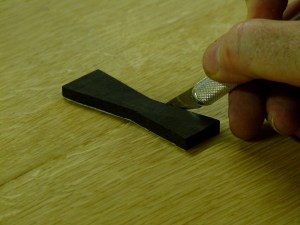
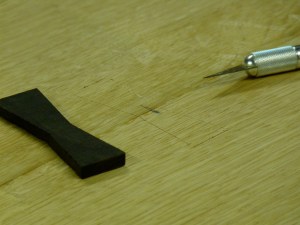
To start each inly, I scribed some double sided tape to the butterfly and placed into position. Its a lot easier to scribe around it if you are not trying to hold it in place with one hand. I used a basic X-Acto knife to scribe around it. Start out with a light, careful cut, angled in to be as tight as possible. The goal is accuracy, not depth. Multiple passes will get the lines deep enough. Cross grain is not a problem, but you have to be extra careful going with the grain, so that your knife follows the outline, and not the grain.

doublesidedxacto

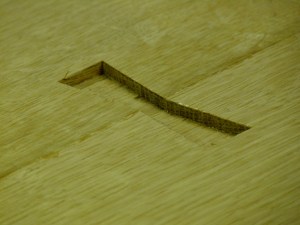
Next, I carefully follow the scribed lines with my chisel. Not going too deep, which might wedge them open with the chisel’s bevel, just enough to create a stop for the next step; which is chiseling out a small wedge to the line. This provides a visual boundary when routing out the waste, and, more importantly, provides a guides for the final chiseling.

ledgeoutline

I set the depth of my laminate trimmer with a spiral cut bit to be a little less than the depth of the butterflies. Then carefully start it up and plunge it in, routing as close as you dare to the edges. Don’t worry about getting ultra close; that’s what the chisel is for. After routing, use the ledge to guide the chisel in chopping all the down to the line, being careful to go straight down, or even slightly undercut. Again, start with the cross grain edges first, and finish up with the edge going with the grain. The hard part is over.

routedexcavated

Unless the chisel or (horror of horrors) router got too wayward, the fit should be nearly perfect. I use liquid hide glue for the inlaying. It has good gap filling properties, if necessary, and it doesn’t affect any stains or finishes, which is critical. As a precaution, I save some of the dust from the routing process, and rub it around the inlay. This fills in any slight gaps so that they all but disappear.

gluedThe next day (make sure to wait a full day when using the hide glue) they are ready to be planed flush with a block plane. The ebony dust, while it makes beautiful black curls, will stain the oak, but that comes out in the final surface planing and/or sanding.

planed

And, finally, the entire table top (although, with the extension leaf on the side, rather than its final central position), still to be cut to finished dimensions.

fulltop

Panel discussion in a parallel universe

Posted in Acorn House on June 27, 2009 by acornhouseworkshop

With the table base in the finishing room getting a daily coat of wipe-on poly, and the light box finished and delivered, it’s time to get to work on the table tops. The two main tops will be 30″ wide each, with a 24″ extension leaf (4′ side to side for all). That means about 18 rough board to be milled: crosscut, ripped, face jointed, thicknessed and edge jointed. As I started to joint the face, I noticed that I was getting an uneven cut, leaving me with a thick and a thin edge to the board. Not good, as I wouldn’t have enough thickness left after planing. After some discussion of the problem on the Fine Woodworking Knots forum and a careful examination of the jointer, I realized that it was in desperate need of new knives. No problem, I had some on hand, ready to go.

Jointer knives are held in by square gib screws. Small ones. I tested wrenches until I found the size that seemed to fit them; 8mm. A couple obliged by loosening, but the others would not budge. The fact that the wrench was such a small one didn’t help matters; not much leverage. I decided to soldier on with the knives as they were, and managed to get all of the boards ready for the thickness planer. I spritzed some penetrating lubricant on the screws to work while I thcknessed the baords, ending up with a good 1″ thick top. The next day, I got some more advice on dealing with stuck screws from Eric Mattson, the Fine Woodworking teacher here at Rio. So I gave it another shot. First, I double checked the screws with a caliper, seeing if an imperial wrench would work, and, what do ya know, they were 5/16″ on the nose. So, with a change of wrench (still small, but now perfectly snug), and a few judicious taps with a wooden mallet (works much better than the hammer that I had tried before; less bouncing. Thanks, Eric!), I managed to get ALL of the screws loosened, and the knives changed. O so much better!

With the boards for the top milled to size, it was time to decide which one would go where; who worked best next to who; and which ones would gave me the right width for the three panels. I had already decided on the top side during the milling process. So I had to spread them out against the wall workbench, all 7+ feet of them. I settled on a pleasing, harmonious arrangement, and got ready to glue. Instead of trying to glue too many at the same time, I broke it down into 5 glue ups: 2 per main side, and 1 for the extension. That lessened the risk of warpage during clamping, and reduced the frantic level.

Once all the glue ups are finished, I will get to work on the ebony butterfly inlays.

Happy Father’s Day

Posted in Acorn House on June 21, 2009 by acornhouseworkshop

The Dark Walnut Danish oil took forever to stop seeping up around the base of the corbel slats. I had to wipe the excess every few hours for about 5 days! Thinking back, I think I have deduced the cause. When I was routing the mortises for the corbel slats, I made them a bit wider than necessary, to allow myself some extra wiggle room to adjust them. Since they are non-structural, I didn’t think anything of it. When I applied the Danish Oil, the extra spaces must have filled up, and the excess had slowly been drawn up, and out, over the ensueing days. Annoying, but, in the end, no real biggie. I mixed up a fresh batch of dewaxed orange shellac to seal it, and got that sanded to 320, ready for the first coats of the wipe-on poly.

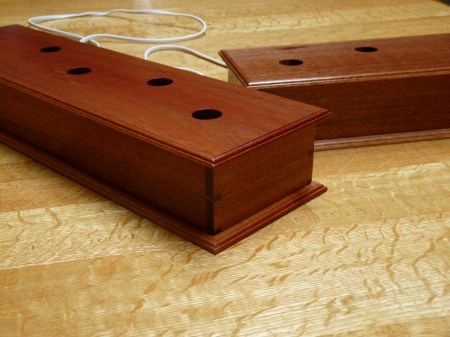
While waiting for the oil to stop seeping, I took the opportunity to work on my Father’s Day present. My father collects glass paperweights and expressed a desire for a light box to display them on; basically, a box with a light inside, shining up through holes into the paperweights. I found some mahogany for the sides, and milled it down to a little less than 3/8″, a real change from the heavy 8/4 oak that I had been dealing with. I decided to get some dovetailing practice in, since I hadn’t done any in a while. It was going to be a challenge, as well, working with such thin stock. Practice certainly makes perfect. I could see a progression in quality from the first to the last; but they were all good enough to do their job. (no overly floppy, loose ones) My biggest issue is not sawing past the line. I always seem to overshoot it a fraction, especially on the pins. I need to work on that. Mahogany is such a hand tool friendly wood, no wonder it became the wood of choice for Chippendale, et al. I made two boxes, and they glued up nice and square, thanks to the dovetail joints.

For the base and lid, I didn’t have any suitable mahogany, but I did have an isolated board of Lyptus, the newly developed eco-friendly wood. Certainly similar in color and grin, but definitely not as friendly as mahogany. It is much denser and less hand tool friendly. I don’t think I will make it a regular part of my arsenal, unless specifically requested (and I can’t talk them out of it.) I attached the top to the sides, drilled the holes for the light – and the light’s electrical cord – and sanded them, ready for the finishing room. About five coats of a wiped on oil/varnish blend and they were ready. It certainly brought out the luster of both the mahogany and the Lyptus.

They were much appreciated.

lightbox

Well, that’s just nutty!

Posted in Acorn House on June 10, 2009 by acornhouseworkshop

I muscled the base into the back of the car and drove it to the main garage (i. e. finishing room) without managing to do any damage. At least none that I could see. (memo to self: next project, use balsa wood!) A final sanding with 180 grit then a wipe down with a tack cloth and we’re ready to finish the base. Ideally, I would finish the base and top together, to make sure they are consistent, but I don’t have the space for that. I’ll finish the base while I’m working on the top, then move the top in for its finishing.

Normally, I am an big exponent of a natural finish, letting the wood’s natural beauty shine through. That’s how I finished my own dining table of QSWO. And, being under some skylights has really brought out the wood’s depth and chatoyence  over the years. However, this table is going into an older home, with dark, stained oak trim, floors, and, of course, the buffet. A natural finish would be out of place. Fuming is out of the question. Its bad enough riding by when farmers put ammonia on their fields, I don’t relish choking. Their are many recipes for a faux-fumed, traditional Arts and Crafts look, many involving multiple color steps: dyeing, sealing, adding filler, sealing, staining, sealing again, glazing, sealing, top coating, waxing… and on and on and on. I sometimes think people try to make it more arcane than it needs to be, not that the results from those methods are bad, I just don’t think its necessary. 

My recipe (not really mine, Bob Flexner writes about it) goes back to authentic, early century, alternatives to fuming. In some of the original how-to articles on Mission furniture (c. 1909), they talk about using an asphaltum varnish. Luckily, that formula is already available commercially in dark walnut Danish Oil, put out by a few different companies (I’m using Watco). I flood the surface, let it sit for about a half hour, apply another coat, let it sit for another 15 minutes, then wipe everything down, leaving nothing on the surface. (Making sure to go back in a few hours to wipe down any areas that has come up while sitting, as with all danish oils. Usually around joints. And then back again to rewipe. And then back again….. STOP POOLING!) When this dries (I like to give Danish Oil a few days to dry), I’ll seal with a thin coat of dewaxed orange shellac, then finish with some coats of a wipe on poly. I don’t predetermiune the number of coats, I just keep adding coats until I get the buildup and look that I like. Since this is a dining table, I want to make sure the top is well protected. 

Hmmm, maybe I should’ve just used walnut to begin with?!?

nutty

Loocy, you got some splining to do!

Posted in Acorn House on June 7, 2009 by acornhouseworkshop

The table base is – save some finish sanding – finished.

I refined the shape of the stretcher, adding the cloudlifts, using the original bow to the stock as my arc. Even though it still is no fun, by this one, my routine for smoothing out the bandsaw marks in the QSWO is pretty well perfected: start with a microplane to do the initial shaping, then move to the rasp, then a smooth cut file, then a flexible sanding strip, then the random orbit sander. Then check the curves from a number of different perspectives and make any touch ups necessary. Test fit and work on the shoulders some more, then arc and pillow the through tenons and cut the slots for the splines. Check.

The design for the extension mechanism comes from Stephen Brandt, via Dining Tables by Graves and Zager. It uses a groove in the side aprons and a slide attached to the table top. Instead of routing the channel out (which I was not looking forward to with the oak), and then having to square up the ends with a chisel, I used the table saw and dado blade to run a channel all the way through the apron, and then glue in inserts to fill the groove in the tenons. A lot quicker, a lot less wear and tear (and tearout), and a lot less stress.

The glue up was mostly about figuring out the best clamping strategy, making sure I protected the oak from any clamp marks and iron staining. I used a band clamp with corner protectors to pull the top together, and a couple of aluminum (or aluminium for those of you on the other side of the pond) to pull the bottom rails tight to the stretcher. Bar clamps up top tightened all of the gaps in the aprons (had to back off a bit when they started to bow!). Then it was time to spline. I was careful to get all of the ebony splines tapped in equally on both sides, so that they would leave the same width of ebony revealed. Check the corners for square, and then BREATHE!

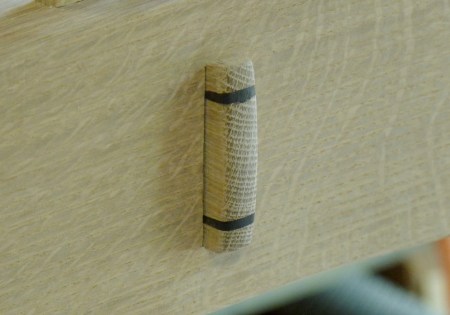
Then to the time consuming fiddly bits. All of the tenons got pegged with oak dowels – 1/2″ or 3/8″ – and then, after they had dried, I used a forstner bit and two different sizes of hollow chisel mortisers, (just the chisel part of the set) to create the square mortise for the ebony plugs. Here’s a tip, use a mortise chisel larger than your forstner bit so you don’t get a bulging square. Luckily, past experience helped me out there. A couple of chisels to clean out the waste, and voila, lots of square, flat-bottomed, holes, all the same depth, just waiting to be plugged up. Then cutting the ebony and pillowing the ends before cutting them to length. (I really do prefer the G&G pillowed plugs to the Stickley style, with champfered pyramids; even though its a bit more work.)

Next, I’ll do a bit of final sanding and move the base to the finishing room, so I can have room to work on the top. Just keep plugging away…oh wait, I’ve already done that.

pluggedspline

Bow, bow, bow your base…

Posted in Acorn House on June 2, 2009 by acornhouseworkshop

Yesterday, I got the side assemblies ready for glue-up. Everything got sanded to 120 and all of the edges got eased. Also, I rechecked all of the tenon shoulders and made my final adjustments. The through tenons got an arc treatment and then pillowed, ala G&G. After figuring out my glueing and clamping strategy, making sure I don’t get any glue on the exposed end of the tenons, we were off. Its always a little nerve racking, doing a major assembly, trying to get enough glue, but not too much, on the tenons; and trying to get everything fitted together and clamped before the glue starts to set up. Since I only have two parallel jaw clamps that were long enough, I did each side seperately. But, no real problems, everything went fairly smoothly.

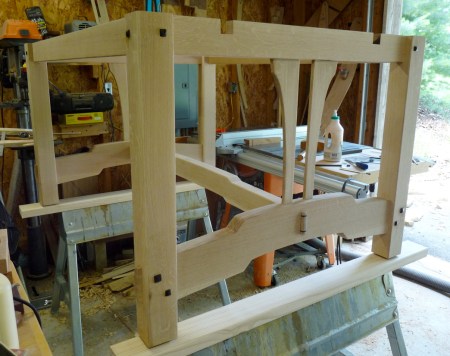
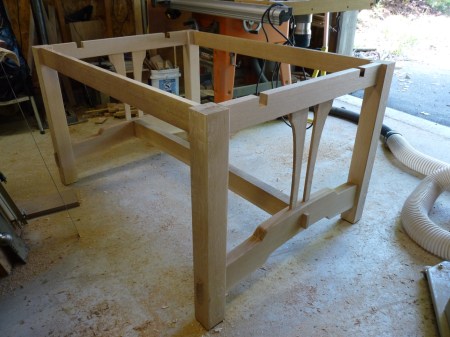
Today, the task was a tricky one. For the central stretcher, my supplier had a bowed 8/4 piece that I thought would work perfectly, design-wise, allowing me to get my arc without wasting wood, or having to find even more wide 8/4 QSWO (not the easiest, I had to try a number of suppliers before I found someone who had the 8 inch wide stock I needed for the bottom side rails). Of course, the challenge with a board that comes pre-arced, is that I had to make my square through tenons on unsquare stock. Once again, a combination of tenoning jig, table saw, band saw, dozuki, chisels and shoulder planes was the answer. I still need to adjust the shoulders as well as do the final shaping and sanding of the stretcher, but the joinery is, essentially, done. These through tenons will be wedged,with the same arcing and pillowing,  whereas the other main tenons will be pegged and plugged.

Once that is done, all that is left for the base is to rout the channels for the extension slides in the aprons, ease edges, sand and glue. Then I can move the base out of the shop, to the finishing room (the main, attached, garage) and start work on the table top.

…merrily, merrily, merrily merrily, life is but a beam.

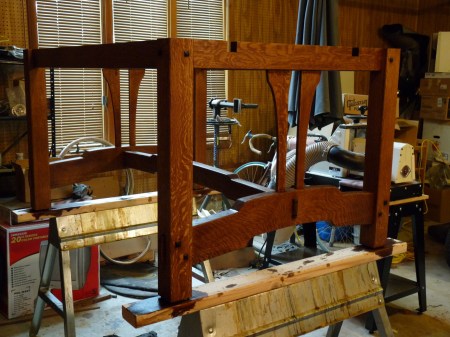
base

A little to the right…

Posted in Acorn House on May 27, 2009 by acornhouseworkshop

I got the side slats made up yesterday. I had been debating what shape they would be: should I echo the bottom rail curve and cloud lifts; two slats curving out from each other; basic straight slats…? I couldn’t come up with a design that I really liked. Looking through my Greene and Greene books didn’t offer many solutions, so I looked at every Arts and Crafts/Stckley/Mission era piece that I could. None of the tables offered anything interesting, but then I found myself looking at a corbel from a Morris chair. AHA! Paired corbel slats, quasi bookmatched (I couldn’t actually bookmatch them, since there is usually one good ray fleck side and one less figured side. Resawing means I have to use the same side orientation.)

This morning I worked on the mortises for the rails and prepared the upper tenon on the slats. Since the bottom rail is curved, I had to wait until I had the bottom rail cut, so I could match the curve to the bottom tenon on the slat. Of course that also means I had to fair the curve after sawing. Sam Maloof (on every woodworkers mind, now) had said that he likes walnut, not only because of its beauty, but because it is a friendly, forgiving wood, unlike, say, QSWO! Smoothing out bandsawn curves in oak is a seemingly endless task. It makes me wish I had gone with a more traditional, rectilinear, A&C design. Oh well. I got the top of one of the rails ready to fit the bottom of the slat, and got everything put together. There is still more filing and sanding (and whatever other tool I can come up with to get the job done) to go on this rail, not to mention the second one….AND the center stretcher. 

Talk about a winding road.

side

Sam Maloof 1916-2009

Posted in Acorn House on May 27, 2009 by acornhouseworkshop

I was saddened today to learn of the passing last Thursday of a true creator. Sam Maloof has been dubbed one of America’s treasures, and that he truly was. He brought a new vision to the world of furniture, making useful objects that transcended their utilty and became true art. He, however, thought of himself as a woodworker. That was an honest word to him. He just wanted to make beautiful things for people to live with. Integrity was important to him, he wanted to have that connection with the people who bought his pieces, as he felt a connection to the makers of the pieces that he surrounded himself with. He even turned down a business proposition to mass produce his chairs, when he realized that he would have to compromise his designs in order to make them machine friendly, thereby walking away from millions of dollars. He wanted to make sure that any piece with his name was actually made by him.

In my own work, he is, more than anyone else, responsible for pushing me to move beyond straight lines, to look for the curve, for the organic. I still have far to go, but his work will always be there to drive me onward.